Why Education Is Undergoing Its Biggest Transformation in Centuries
For centuries, the classroom experience remained remarkably unchanged. A teacher stood at the front, students sat in rows, and knowledge was delivered through chalk, textbooks, and handwritten notes. Then the internet arrived, and with it began one of the most profound shifts in human learning since the printing press.
But what we are witnessing in 2026 feels different — not just an evolution, but a revolution. Artificial intelligence, immersive tools, and ubiquitous connectivity are converging to reshape not just how we learn, but who gets to learn, where learning happens, and when it takes place. Whether you are a student in Warsaw, a professional in Mumbai, or a retiree in São Paulo picking up a new hobby, the landscape of education has never been more dynamic, more personalized, or more accessible.

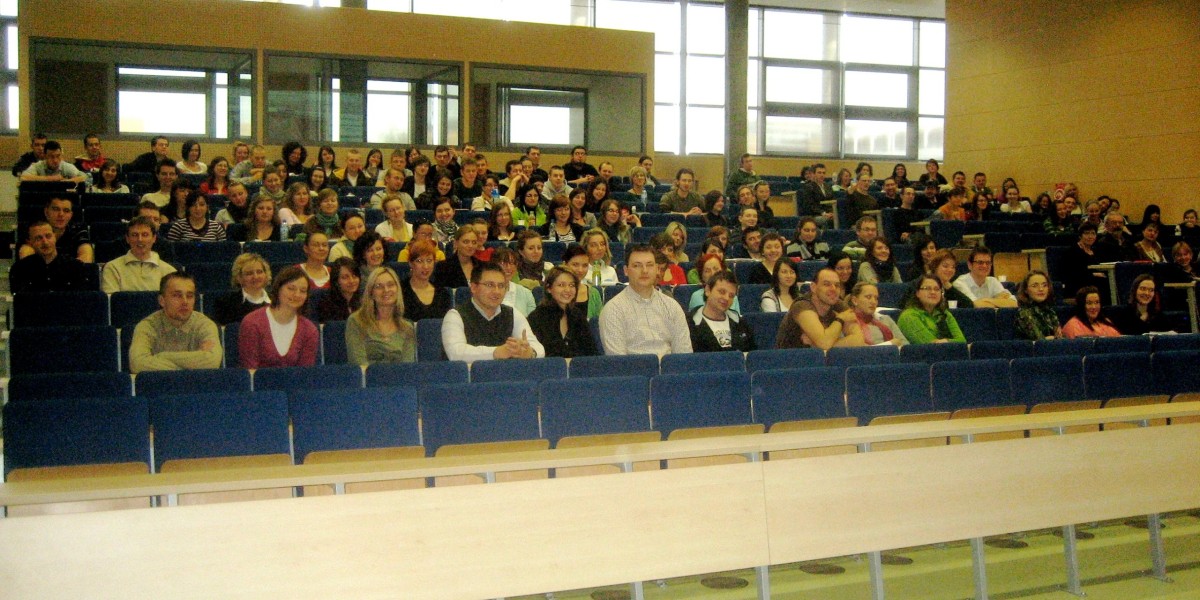
? Photo: David Silver's lecture to students at Adam Mickiewicz University
Photographer: David Silver
License: CC BY-SA 2.0
Source: Wikimedia Commons
The Personalization Revolution: AI as Your Study Partner
Perhaps the most significant shift in modern education is the move from one-size-fits-all teaching to deeply personalized learning. AI-powered platforms like Khanmigo (from Khan Academy), Duolingo's new roleplay features, and tutoring systems built on large language models are making it possible for every learner to have a dedicated, infinitely patient study companion.
These AI tutors do not simply provide answers — they adapt. They notice when a student struggles with quadratic equations but excels at geometry, and they adjust the pace accordingly. They generate practice problems tailored precisely to the learner's weak points. They explain the same concept five different ways until something clicks, without any of the frustration a human tutor might feel after repeating themselves for the tenth time that week.
Research from Stanford University's Human-Centered AI Institute has shown that well-designed AI tutoring systems can improve learning outcomes by 30–50% compared to traditional lecture methods, particularly for students who are struggling. The key word is well-designed — not all AI tools live up to this promise, and the quality of the underlying pedagogy still matters enormously.
The Rise of Micro-Learning: Knowledge in Bite-Sized Chunks
Your average human attention span in 2026 is not what it was in 2000 — and educational platforms have responded. The explosion of micro-learning reflects a broader cultural shift: people want to learn things in 5-to-15 minute bursts, not just in semester-long marathons.
Platforms like Coursera, LinkedIn Learning, and MasterClass have introduced snackable content alongside their longer courses. YouTube EDU channels from institutions like MIT, Stanford, and The Khan Academy reach millions daily. Even traditional universities are breaking their lectures into podcast-length segments designed for the commute, the gym, or the lunch break.
But micro-learning is not just about convenience — it is backed by solid cognitive science. The spacing effect, first identified by psychologist Hermann Ebbinghaus in 1885, shows that we remember information better when we are exposed to it at intervals over time rather than crammed all at once. Apps like Anki and Quizlet leverage this principle, serving up flashcards exactly when your brain is about to forget them. This "spaced repetition" approach is one of the most validated learning techniques in educational psychology, and AI has made it seamless.
Immersive Learning: Stepping Inside Your Subject
Reading about the Roman Columseum is one thing. Putting on a VR headset and walking through it as it looked in 80 AD, hearing the crowd roar and the gladiators clash, is something else entirely. Immersive technology is making experiential learning possible at scale for the first time in history.
Medical students at Case Western Reserve University in Cleveland, Ohio, now dissect virtual cadavers in 3D before ever setting foot in a real lab. Engineering students at ETH Zurich walk through the inside of jet engines. History classes at the University of Glasgow recreate ancient Scottish settlements where students can interact with digital reconstructions of artifacts.
The cost of VR headsets has dropped dramatically — the Meta Quest 3 can be purchased for under $500, and mobile-based AR experiences cost nothing beyond your smartphone. Companies like Labster and zSpace are building virtual science laboratories where experiments that would be too dangerous, expensive, or time-consuming in real life can be performed safely and infinitely.
Meanwhile, augmented reality tools are being used to overlay real-world information onto physical objects. Point your phone at a star and see its name and constellation. Hold it over a historical monument and watch it reconstruct itself to its original glory. Scan a piece of mechanical equipment and see animated repair instructions overlaid on the actual parts.
The Global Classroom: Breaking Down Borders
One of the most quietly revolutionary aspects of the education technology boom is its ability to reach learners regardless of geography. A student in rural Tanzania with a smartphone and a five-dollar monthly data plan can now access the same MIT physics lectures as someone living in Boston.
This democratization has profound implications for global equity. Organizations like UNESCO and the World Bank have invested heavily in digital education infrastructure across Sub-Saharan Africa and South Asia. The African Leadership University has built a model where students rotate across campuses in multiple countries, blending online and in-person learning. India's SWAYAM platform serves millions of learners across the subcontinent with courses from top professors at IIT and Delhi University.
Language barriers — long one of the biggest obstacles to global learning — are dissolving as real-time AI translation becomes standard. Google's new universal translator features, AI subtitle generation on YouTube, and automated dubbing tools mean that a great lecture delivered in Korean can be understood by a student in Portuguese with surprisingly high accuracy.
Skills Over Degrees: The Credentialing Revolution
Another major trend reshaping education is the shift from degree-centric to skills-centric hiring. Major technology companies including Google, Apple, IBM, and Netflix now emphasize skills and portfolio work over traditional four-year degrees in many of their hiring decisions. Google's own Career Certificates program — six-month online courses in fields like IT Support, Data Analytics, and UX Design — was explicitly designed as alternatives to a bachelor's degree.
This is not to say universities are going anywhere. Degrees from prestigious institutions still carry enormous weight, and many professions — medicine, law, engineering — require formal accredited credentials. But the monopoly of the traditional degree has been broken. Employers increasingly care about what you can do, not just where you studied.
The rise of portfolio-based assessment, where candidates demonstrate their abilities through real projects rather than standardized test scores, is gaining traction across disciplines. Platforms like GitHub for developers, Behance for designers, and Kaggle for data scientists have become de facto professional credentials in their domains.
The Human Element: What Technology Cannot Replace
Amid all this technological transformation, it is worth remembering what no AI or VR headset can replicate: the spark of inspiration that comes from a great teacher. The mentor who sees potential in a struggling student. The study group that debates an idea long past midnight. The laboratory accident that teaches resilience.
The best educational technology does not try to replace human connection — it amplifies it. AI handling the repetitive aspects of teaching (grading basic quizzes, generating practice problems) frees human educators to focus on what they do best: inspire, mentor, challenge, and support. Flipped classrooms, where students absorb lecture content at home and use class time for discussion and problem-solving, are a direct result of this rethinking.
According to Andreas Schleicher, head of the OECD's education division, the most successful education systems of the future will be those that "combine the power of technology with the wisdom of human judgment." Technology is a tool, not a solution — and the best learners are the ones who understand this.
Practical Steps to Embrace the New Learning Landscape
Start small, stay curious. You do not need to overhaul your entire approach to learning overnight. Here are concrete steps anyone can take right now:
• Pick one micro-learning habit: Subscribe to one educational YouTube channel or podcast in your area of interest, and consume one short segment daily during your commute.
• Try an AI tutor: Platforms like Khan Academy's Khanmigo, Coursera's in-course AI assistants, or even large language models set to tutoring mode can provide personalized explanations for virtually any topic.
• Explore free online courses: edX, Coursera, Khan Academy, MIT OpenCourseWare, and YouTube EDU offer free access to world-class instruction on virtually any subject imaginable.
• Add spaced repetition: Even a basic flashcard app like Anki can dramatically improve retention of facts, vocabulary, or formulas if you use it consistently.
• Join a learning community: Online forums, Discord servers, and local meetups focused on your area of interest provide accountability, collaboration, and motivation that solo study cannot match.
Looking Ahead: Education in 2030
The trends we see today — personalization through AI, immersive experiences, global access, and skills-based credentials — will only accelerate in the coming years. By 2030, it is entirely plausible that the average "student" will be someone juggling AI-driven learning while working full-time, pulling up an AR overlay to fix a machine at work, or spending an evening in a virtual classroom with peers from five different continents.
The learners who will thrive are not those with the most advanced tools, but those with the most adaptable mindset: comfortable with change, eager to experiment, willing to fail and try again. In a world where knowledge evolves as rapidly as the technology that delivers it, the most important skill of all is learning how to learn.
? Explore more on Education & Learning:
#Education #AILearning #OnlineLearning #Technology #EdTech #FutureOfLearning #OnlineCourses #Microlearning #VR #StanfordResearch